
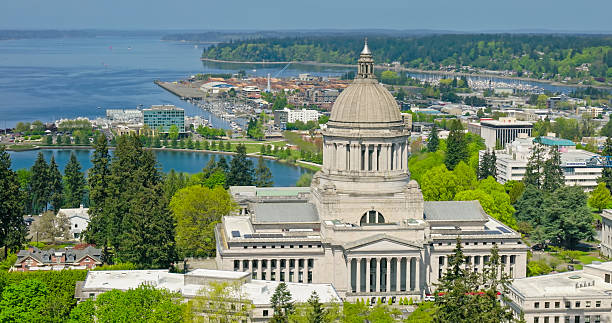
How State “Trigger” Laws Are Reshaping Employer Compliance: A Washington State Study
Last Updated on April 21, 2026 by MyHRConcierge
As states continue to respond to uncertainty at the federal level, Washington has become the latest state to adopt a so-called “trigger” labor law (HB 2471)- legislation designed to activate state-level oversight of private-sector labor relations if federal protections are weakened or become unenforceable. The new law, which takes effect June 11, 2026, signals a notable shift in how labor relations could be governed in the United States and raises important compliance considerations for employers operating across multiple jurisdictions.
What Is a “Trigger” Labor Law?
A “trigger” labor law is a state law designed to take effect only if certain conditions are met at the federal level. Until those conditions occur, the law typically remains inactive.
In the labor context, these laws are meant to act as a backup system. They are structured so that if the federal framework- primarily enforced by the National Labor Relations Board under the National Labor Relations Act– is weakened, limited or unable to function effectively, the state can step in and assume regulatory authority.
Practically speaking, a trigger labor law would allow a state to begin overseeing areas such as union elections, collective bargaining rights and unfair labor practice claims, but only if the predefined “trigger” event occurs. That trigger could include scenarios like a court ruling that restricts federal enforcement, significant changes in federal policy or a breakdown in the NLRB’s ability to operate.
For employers, the key distinction is that nothing changes immediately. However, these laws introduce a conditional layer of regulation that could activate quickly, potentially shifting oversight from federal to state authorities with little lead time.
Why “Trigger Laws” and Washington’s Passing Matters Now
The passage of this law in Washington reflects growing concern among some states that federal labor protections could become inconsistent or limited due to political, judicial or administrative changes. By creating a contingency framework, Washington is positioning itself to maintain continuity in labor relations governance regardless of shifts in federal authority.
For employers, this introduces a layer of uncertainty. While the law may never be activated, its existence requires organizations to monitor both federal developments and state-level responses. Businesses operating in Washington should be prepared for the possibility of dual or alternative regulatory agencies, particularly if federal oversight is disrupted.
A Growing Trend Across States
The emergence of “trigger” labor laws reflects a broader national response to uncertainty surrounding the federal labor framework, particularly the role of the National Labor Relations Board under the National Labor Relations Act. As legal challenges, political shifts and questions about the agency’s long-term authority continue to surface, several states are taking proactive steps to ensure labor protections remain intact. However, this is a movement that the National Labor Relations Board strongly opposes and is actively challenging in courts.
States such as California, New York and Massachusetts have introduced or enacted similar contingency-based laws designed to prevent a regulatory gap if federal oversight is weakened or disrupted. These laws are intended to serve as a safeguard, allowing states to step in and oversee private-sector labor relations in the absence of effective federal enforcement.
What distinguishes Washington’s approach is its level of specificity and readiness. Rather than simply establishing a conceptual framework, Washington’s law outlines how the state would operationalize labor oversight, including enforcement authority and administrative processes. It also adopts a more flexible trigger standard, allowing activation not only in the event of a complete federal breakdown, but also when federal protections are significantly limited.
Together, these developments point to a gradual shift toward increased state involvement in labor relations- an area historically dominated by federal law- and signal a more complex compliance landscape for employers moving forward.
Have Questions?
Get answers to questions about government rules and regulations that may affect your business by using MyHRConcierge. We provide expert guidance to employers that helps them stay compliant with state and federal labor laws—fast.
The NLRB’s Position and Legal Challenges
The National Labor Relations Board has expressed strong opposition to these state-level initiatives. The agency maintains that federal labor law, primarily established under the National Labor Relations Act, preempts state regulation of private-sector labor relations. From the NLRB’s perspective, allowing states to step in (even conditionally) undermines the uniformity and consistency that federal oversight is intended to provide.
As a result, the NLRB is actively challenging these laws in court, arguing that they conflict with long-standing legal principles of federal preemption. The outcome of these challenges will be critical in determining whether “trigger” laws can withstand judicial scrutiny or if they will be invalidated before ever taking effect.
The National Labor Relations Board is widely expected to challenge Washington’s HB 2471 in court. As seen in recent cases, federal district courts have already issued temporary injunctions blocking similar laws in New York and California, suggesting Washington’s law could face a comparable outcome- potentially even before it takes effect.
That said, Washington lawmakers appear to have drafted HB 2471 with these legal challenges in mind. The statute’s triggering language is more narrowly tailored, referencing the “previously existing jurisdiction” of the National Labor Relations Act and the “previous jurisdiction” of the NLRB. By contrast, New York’s approach is broader, permitting state intervention if the NLRB does not “successfully assert jurisdiction,” a standard that may be more vulnerable to preemption challenges.
Employer Considerations Moving Forward
For employers, the key takeaway is not immediate operational change, but heightened vigilance. Organizations should closely monitor legal developments at both the federal and state levels, particularly any court rulings that may clarify the enforceability of these laws.
Employers with a presence in Washington and other states pursuing similar legislation should also consider reviewing their labor relations strategies, ensuring they are adaptable to potential regulatory shifts. While the current federal framework remains in place, the emergence of “trigger” laws underscores a broader trend toward state-level intervention that could reshape the labor law landscape in the years ahead.
The Bigger Picture
Washington’s new law represents more than a contingency plan. It is part of a larger conversation about the balance of power between federal and state governments in regulating the workplace. As legal challenges unfold and additional states consider similar measures, employers may find themselves navigating an increasingly complex and evolving compliance environment.
Staying informed and proactive will be essential. Whether these laws ultimately take effect or are struck down, they signal a growing willingness among states to step in where they perceive gaps in federal oversight, which is an important development that no employer can afford to ignore.
For more information on how to enhance your organization’s compliance efforts, contact MyHRConcierge at 855-538-6947 ext.108, ccooley@myhrconcierge.com. Or, schedule a convenient consultation below: